
In my experience in higher education, leadership is not generally aware of the cost savings an efficiency-minded web developer can yield; instead, web workers are generally viewed as simply the ones who make it all look pretty. It’s true that we should be able to make it look pretty, but there are significant savings to be had for organizations who invest in a quality developer with experience creating user-focused tools to help web managers get content online faster and with better quality outcomes. In my portfolio, I have several examples of tools I have created that created efficiencies and, thus, saved my organization money.
Harnessing Web Technologies
The biggest part of creating web efficiencies is simply knowing what technologies are available to you in the first place. Though this would seem obvious and expected from anyone qualified to be a web developer, it is not a given. Tech resources will vary from organization to organization and a key component of knowing what you have, especially in a large organization, is being plugged in to your web community and leadership through establishing relationships and participating in your community of practice.
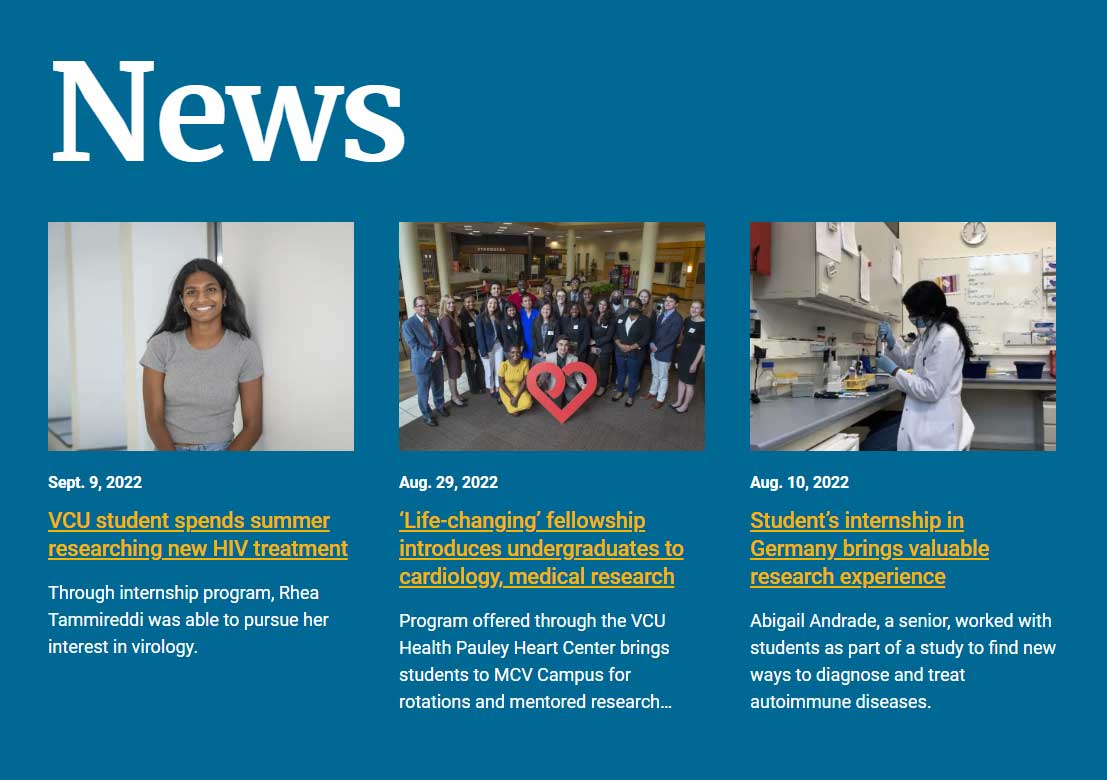
Because I am an active web community member, for example, I learned about the existence of a database feed from my university’s news service that was not being used to its full potential. Together with our web services leadership, I created an integrated newsfeed that solved a major web issue for our 37 websites with a process improvement that saves me alone (and therefore my employer) an estimated 70 hours per year in labor costs. In addition, the aggregate savings from the creation of the integrated newsfeed multiplies across our many other departments resulting in hundreds of labor hours saved per year among all content managers, and thus many thousands of dollars in aggregate. Furthermore, this product wasn’t only a major innovation for CHS, but also for the university and therefore has the potential to help other VCU units achieve savings, as well.
Plugin Development
Developing quality plugins that help content managers do what they need to do faster and better is a top characteristic of a great web developer, especially one who is charged with oversight of multiple web properties. A good plugin lets content managers achieve a quality display with less effort and less expertise, which translates into saved labor hours and potentially, salary savings.
My portfolio contains several examples of plugins I’ve developed that have helped content managers create great displays and yielded savings in labor costs: staff directory plugin, events plugin, news plugin, faculty bookshelf plugin.
Student recruitment is the end goal of all university web work, and higher quality web pages impart to site visitors the sense that our programs are higher quality. Giving content managers—especially those without coding expertise—the plugins to deliver quality displays means websites do a better job of competing for students.
Consider the before/after example below and illustrated more in depth on the Events Plugin page. The ‘before’ image is from an event advertised on one of our sites that does not yet have the new plugin. Note the poor formatting of the text, the absence of an image to make the event more appealing/engaging, the absence of a call-to-action button that cues the visitor to register, etc. This is no reflection on the content manager—they are simply using the tool that they have and do not have experience in HTML or CSS (which they shouldn’t have to have in the first place) to get the display they want. It is up to me to help them do their job better. The ‘after’ image shows what is possible when a content manager has an easy, well-designed plugin with the right fields (date, start time, contact, etc.) and options for uploading media, URLs, etc. that allows them to simply “plug in” the information and out comes a much improved display!
Full Text Before

Full Text After

It would be irresponsible to try and guess at a dollar amount a better quality website can yield in terms of increasing student enrollment. It is something we know intuitively—that a well-organized site with an appealing display is indicative of the organization it represents and thus potentially worthy of our investment—but it is too entangled with a host of other individual, group and systemic factors to tease out an exact value. Still, there IS a dollar value there somewhere. That fact, coupled with the potential labor (and ‘maybe’ salary) savings, means having a web developer who can produce high efficiency plugins and leverage available web technologies is an important piece in a forward-thinking organization’s fiscal strategy.
 Jen Elswick